So Your Family Thinks You're Crazy?
CommentaryBy Guest Writer: Shane Crockett
Published 6 min read
As most Bitcoiners have learned the hard way, Orange Pilling others is no easy task. While Bitcoin is the obvious solution to us for all the well documented reasons, most people are too plugged into their daily lives and pre-existing biases to really stop and ask the hard questions; What is Money, How is Money Created, What Happened in 1971, What is Inflation, etc. As such, we at Bitcoinmath decided to put our own skills and expertise to work to help Bitcoiners augment this mission by bringing the narrative into an objective framework which is hard to argue with when used properly; Math and Data.
By bringing the focus into more narrow and easy to understand financial scenarios people are already familiar with, it’s easier to understand the WHY behind Bitcoin, without actually knowing anything about it. Most people want to preserve and grow their wealth, but look at Bitcoin as a speculative investment similar to Beanie Babies or Tulips, both of which bubbled up and popped in explosive fashion due to the speculative nature of each, and due to the fact they were not Stores of Value, nor did they solve any real problems for people around the world. As Bitcoiners know, BTC is not only a great investment, store of value, and way to preserve and grow wealth, but it also serves as a great way to highlight why other financing, debt, borrowing, investing, and related strategies leave a lot to be desired when the goal is wealth preservation and/or growth.
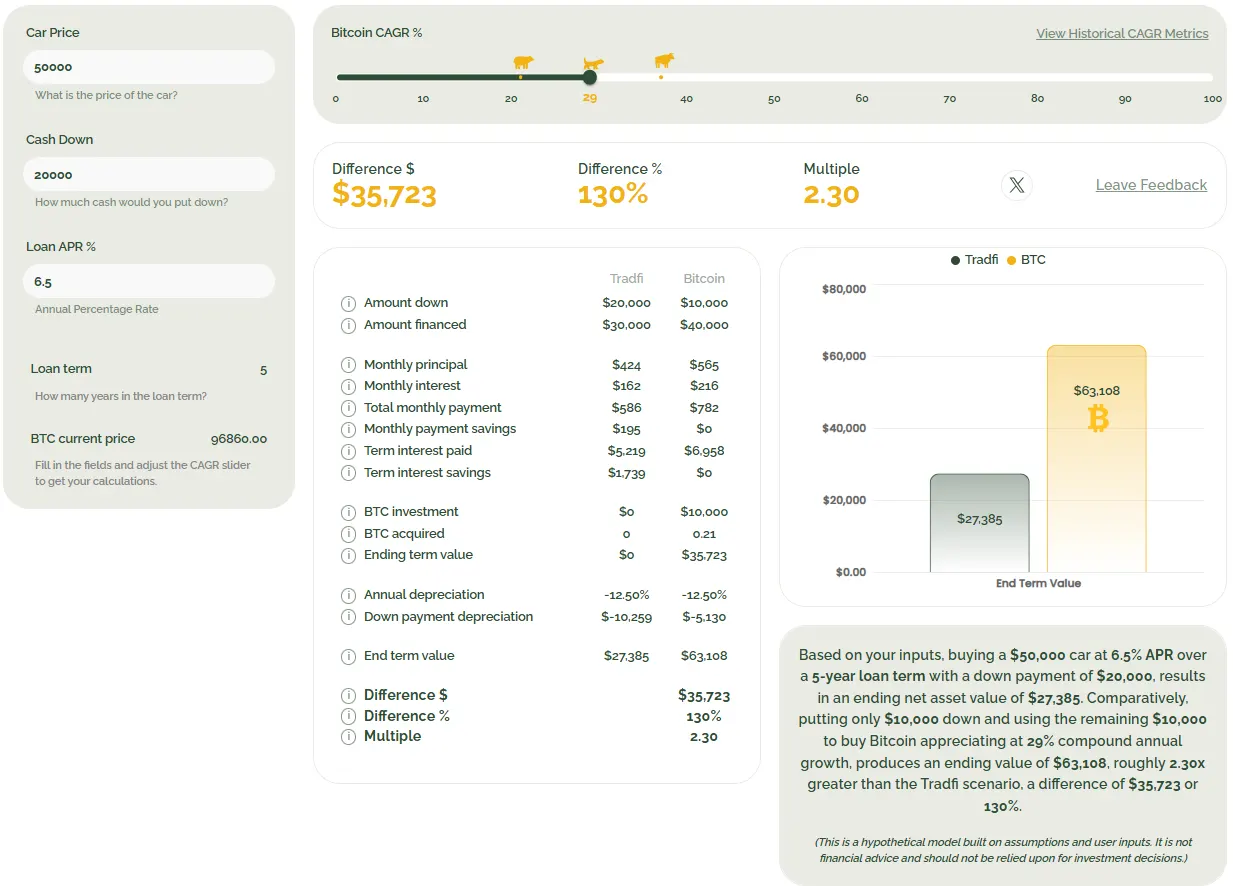
Take for example the Auto and Home Purchase Calculators. Both are meant to showcase the opportunity cost of putting more cash into these assets in the form of larger down payments, and the mathematical results compared to using less cash up front so that economic energy (income) can be used to invest in performant assets such as Bitcoin. Our society has built multiple generations of high time preference consumers who think short term and want more money now, thus prioritize lower monthly payments over long-term wealth preservation. We’ve been led to believe that reducing monthly auto and mortgage payments by putting up more of our hard earned money is better than carrying a larger loan but in reality, this is not always true due to the opportunity cost associated with how we allocate that economic energy.
EXAMPLE 1 - Auto Purchase
EXAMPLE 2 - Home Purchase
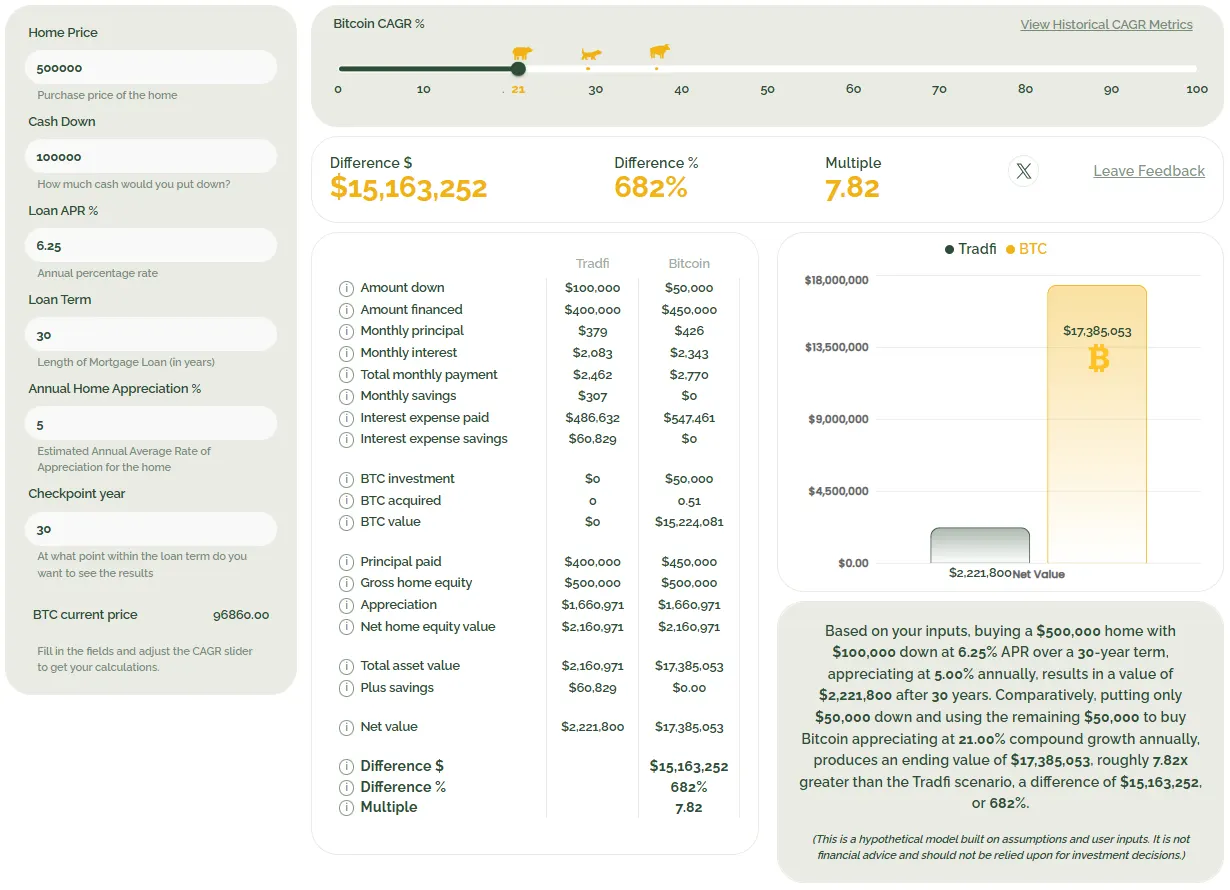
In both Examples, cutting the down payment in half and investing the other half in Bitcoin resulted in significantly higher multiples due to the depreciating nature of car values, and the relatively modest rate of returns for Real Estate. Sure, this means carrying a larger loan and therefore a larger monthly payment, but when we zoom out to the macro objectives, oftentimes people acknowledge they want to preserve and grow their wealth, not have slightly more free flowing dollars each month to spend on “stuff.” When the rate of return on the investment is higher than the cost of borrowing the money, it means there’s a net positive return to be had on the underlying cash used to invest. Granted the Bitcoin CAGR is a projected estimate and not guaranteed, so each user has to model the metrics which make sense to them, and understand outputs are hypothetical and not guaranteed.
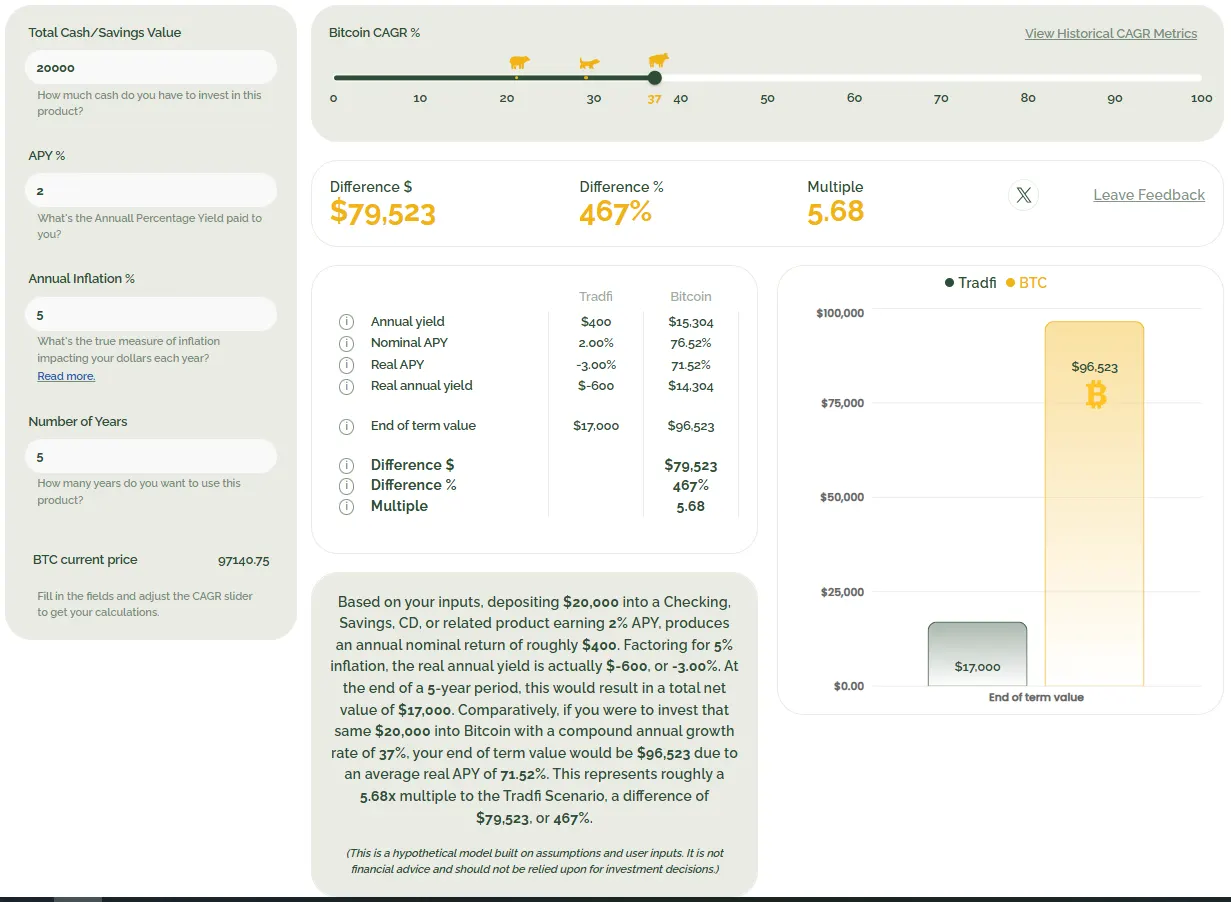
Most people are also blind to the toxic nature of inflation. With The Federal Reserve as your PR Agency, it’s easy to create false narratives about the nature of inflation, what it is, how it works, and what the resulting impacts are, therefore most of us go along with the story we’re told because it’s more convenient than considering the “adults” we believe are taking care of us are actually lying and feeding us false information. CPI (target ~2% YoY) is manipulated based on the goods they choose to put into the basket being analyzed, but when we look at the rate of M2 Money Supply growth over time (~5-7% YoY), it puts all of this into perspective. Our Cash Savings and Living a Bitcoin Standard Calculators model the impacts of inflation very well, demonstrating how even modest inflation metrics of 2-3% YoY can completely erode the value of your economic energy, to the point when getting annual pay increases may not actually put us in a more favorable position as the purchasing power of those nominal dollars goes down every single year.
EXAMPLE 3 - Cash Savings
EXAMPLE 4 - Living on a BTC Standard
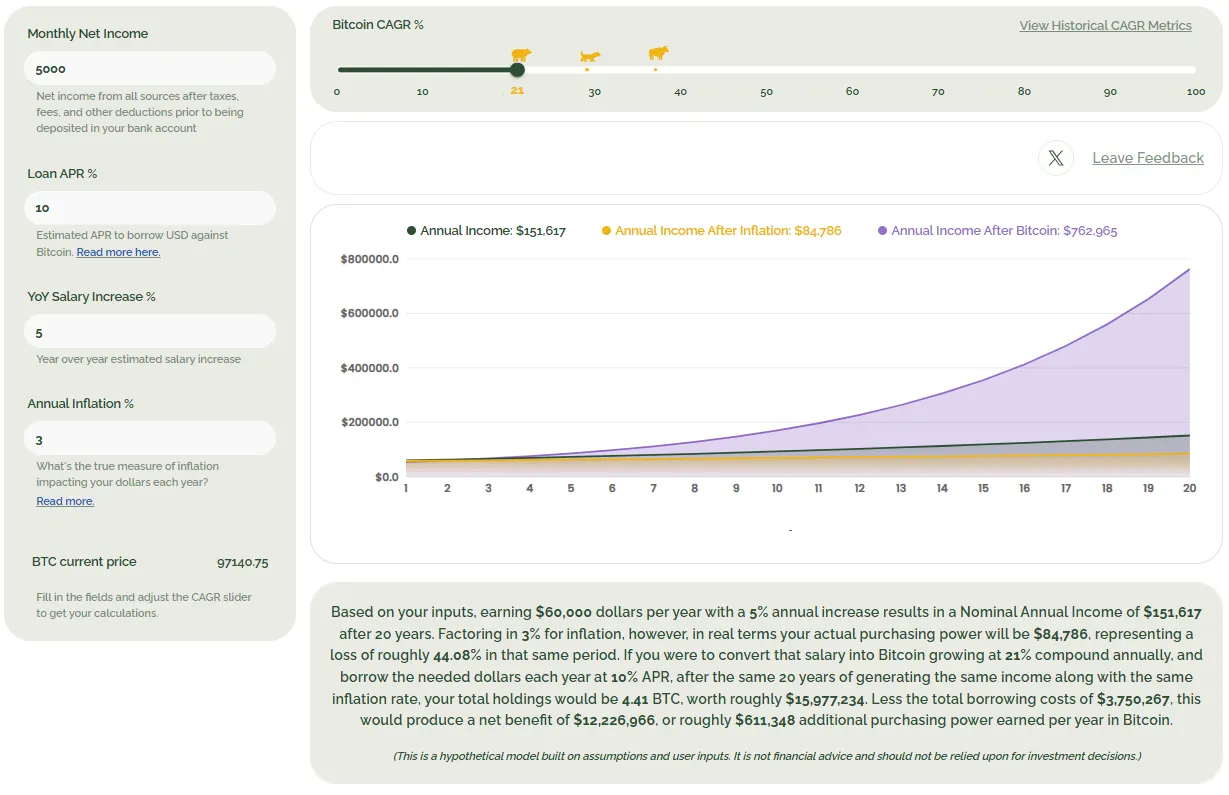
In both examples, nominal increases in USD are either eroded or completely offset by inflation, whereas Bitcoin being the big orange sponge that it is, absorbs inflation better than any other asset class and has for the past 16 years.
So what can we do about it?
Well, from our perspective, people need to see the “Why Should I Care” selling point(s) more clearly, in a language which makes sense to them and can be easily applied to their individual lives. How can Bitcoin help me? What would happen if I…? How does Bitcoin compare to my…? These are questions we aim to help anyone answer for themselves, simply by keying in some basic input values from their own lives into our dynamic real world calculators, to simulate what the future impacts could be vs a Bitcoin powered alternative.
Here are our Calculators
Auto Purchase - Compare the impacts of putting less cash down on a car purchase so more money can be invested into Bitcoin over the term of the loan.
Home Purchase - Compare the impacts of putting less cash down on a home purchase so more money can be invested into Bitcoin over the term of the loan.
Cash Savings - Compare saving dollars in a High Yield Savings or CD to saving in Bitcoin.
Home Equity - Compare retaining home equity value in your residence vs taking out a HELOC and buying Bitcoin.
Retirement Savings - Compare S&P500 Stock Performance to Bitcoin for retirement savings strategies.
529 College Savings - Compare 529 plan returns to Bitcoin over an 18 year period to save for our little ones.
Rental RE Vs Bitcoin HODL - Compare stacking BTC with cash flowing real estate to a basic Bitcoin HODL strategy.
Selling vs Borrowing - Compare the costs to sell BTC for cash, to posting BTC as collateral and borrowing against it.
Living a Bitcoin Standard - Model a 20 year scenario of converting all economic energy (cash) to Bitcoin, and borrowing dollars to live (The Personal Saylor Playbook).
Dollar Cost Averaging (coming soon) - Simulate a DCA strategy over a specified term, and compare to saving those dollars in cash.
Life Insurance (coming soon) - Compare traditional term life insurance with life insurance plans powered by Bitcoin.
With these simple models in-hand, our hope is that the Bitcoin community will be better able to tell the “why Bitcoin” story, continuing to use the important pillars about the current problems with our financial system, the key benefits of Bitcoin’s decentralized P2P protocol, etc, augmented with easy to understand math based models which demonstrate the horsepower of Bitcoin compared to more common financing scenarios most people are already familiar with. By seeing the data and associating Bitcoin with better financial outcomes, we hope more people will reach those ‘a ha’ moments, and begin to ask more compelling questions about how to get involved with Bitcoin or how it works, instead of letting preconceived biases overrule any level of humble curiosity.
As fellow Bitcoiners, we’re always open to input, suggestions, and overall feedback from the community about how to make our tools more useful, so if there’s a calculator in mind you think helps you better Orange Pill the stubborn Uncle next Thanksgiving, please do reach out and let us know!
Guest Writer: Shane Crockett is the Owner/Operator at Bitcoinmath.org
A platform designed to help you understand Why Bitcoin? through dynamic calculators and mathematical models. They've built simple, intuitive calculators that require only basic inputs to generate accurate, data-driven models.