
Collaborative Bitcoin Security
Keep control of your Bitcoin without carrying the risk alone.
Collaborative security protects a large bitcoin holding by spreading control across three keys: you hold one, The Bitcoin Adviser holds one, and a vault company holds the third. Only you can initiate a transaction through your secure vault account. Neither The Bitcoin Adviser nor the platform provider can initiate transactions through the normal platform workflow. Two of the three keys must approve it, and no single party, including us, can move your bitcoin alone.
Talk through your setup. No cost to start the conversation.
The Bitcoin Adviser helps families and long-term holders build client-controlled multisig structures with professional key agency, clear documentation, and continuity support, so their Bitcoin is not dependent on one person, one device, or one point of failure.
Collaborative custody is a custody arrangement. We do collaborative security. We are the key agent in a client-controlled on-chain 2-of-3. We are not a custodian.
- Client-controlled multisig
- Professional key agency
- No unilateral TBA control
- Since 2016
Educational and operational support only. We are not custodians and do not provide financial, tax, legal, or investment advice. Scope, risks & important information →
The problem with Bitcoin custody is not just theft. It is fragility.
Exchange custody
Convenient, but introduces platform, withdrawal, insolvency, and counterparty risk.
Solo self-custody
Powerful, but fragile when meaningful Bitcoin depends on one person, one device, one backup, or one memory.
Full third-party custody
Simple, but gives up the control that makes Bitcoin different.
Collaborative security
A middle path: client-controlled Bitcoin with professional key agency, documented procedures, and continuity support.
DIY multisig, collaborative security, and multi-institution custody
Three common ways people structure Bitcoin control: DIY multisig, collaborative security with a key agent, and multi-institution custody. Side-by-side detail: Compare ownership models.
DIY multisig
You design, operate, and recover the entire key structure yourself. Strong control, full operational burden on you and your family.
Collaborative security (key agent)
Client-controlled 2-of-3. You remain in the signing quorum. A professional key agent is the usual second approval. No single party can move Bitcoin alone. We are not a custodian.
Multi-institution custody
Signing authority sits with institutions. You typically authorise but are not a direct keyholder. Useful for some offices; different from remaining in the quorum.
Client-controlled multisig, with professional support around the key structure.
Your vault has three keys. You control one. The Bitcoin Adviser controls one. The vault company, Theya or Unchained, controls the third. Two of the three keys must approve a transaction before the Bitcoin can move. Only you can initiate a transaction through your secure vault account. Neither The Bitcoin Adviser nor the platform provider can initiate transactions through the normal platform workflow.
No single party can move Bitcoin alone. You remain in a client-controlled structure. The client controls initiation. Two parties control approval. No party controls the Bitcoin alone.
This layer sits underneath how Bitcoin is used over time, including spending and income paths. For educational framing on capital allocation trade-offs (not advice), see Bitcoin income and capital allocation. How day to day and fallback signing work: How signing works.
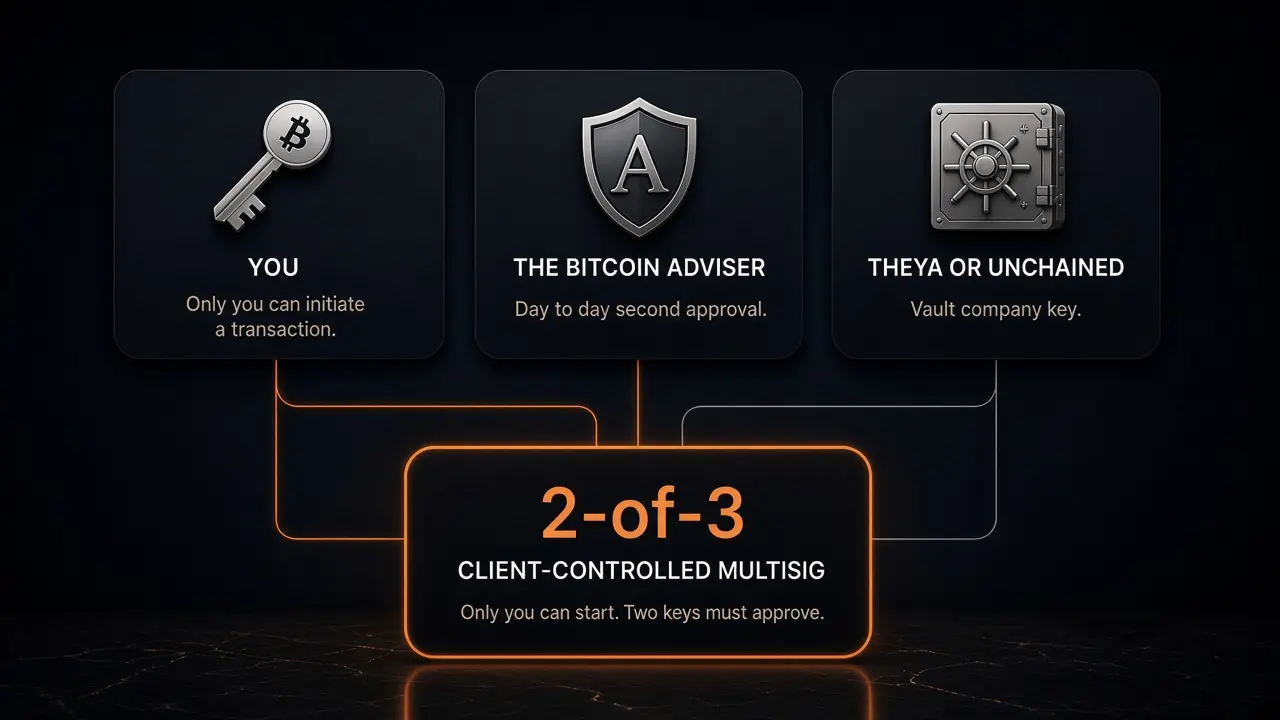
Two keys must approve it before Bitcoin can move.
Only you can initiate a transaction through your secure vault account. Neither The Bitcoin Adviser nor the platform provider can initiate transactions through the normal platform workflow.
1. Initiation
Only you can initiate a transaction through your secure vault account. Neither The Bitcoin Adviser nor the platform provider can initiate transactions through the normal platform workflow.
2. Day to day co-sign
After you initiate a transaction, two of the three keys must approve it before the Bitcoin can move. Normally, those approvals come from you and TBA.
For invoice payments and spends of 1% or less of your vault display balance (measured in sats), TBA can co-sign after you have approved with your key and its security checks are done. Those spends do not require DocuSign, a cooling-off period, or a Confirmation Call.
3. Larger spends (greater than 1%)
After you have signed with your key you complete a DocuSign Signing Request authorisation for that exact transaction, then a cooling-off period applies (default two days from when the request is created in Theya; your vault may use a longer setting), then your adviser completes a Confirmation Call with you before TBA co-signs.
The call provides security checks and guidance. It is not a freeze or permission system. DocuSign does not replace the Confirmation Call. TBA will only approve a transaction after completing its security checks. If TBA cannot assist, that does not make TBA permanently necessary to access the Bitcoin.
4. Fallback if TBA is unavailable
TBA cannot initiate a transaction through the normal platform workflow, move your Bitcoin alone, or lock you out. If TBA were unavailable, you could still initiate a transaction and seek the vault company’s second approval, subject to its security checks.
Your vault has three keys. You control one. The Bitcoin Adviser controls one. The vault company, Theya or Unchained, controls the third.
Three independent keys, protected in different ways
Your Bitcoin is protected by three separate keys: your key, The Bitcoin Adviser key, and a third key held by your vault provider (Theya or Unchained). These keys are created independently, held by different parties, and protected through different technologies and security systems.
Neither The Bitcoin Adviser key nor the Theya or Unchained provider key was generated on, or is stored on, a Coldcard. A vulnerability affecting one device type does not automatically affect the other keys in your vault. No single key can move your Bitcoin.
The Bitcoin Adviser key
Created by combining independent randomness from the signing device and a separate computer, so it did not depend on a single source of randomness. Not generated on, and not stored on, a Coldcard.
The provider key
Separate from both your key and The Bitcoin Adviser key. Not generated on, and not stored on, a Coldcard.
- Theya: Generated using dedicated hardware and stored within specialised, tamper-resistant security infrastructure, accessible only through authorised Theya systems.
- Unchained: Held under Unchained’s own enterprise security controls. Unchained states that its keys are protected through an in-house, geographically distributed security model and an independently audited control environment.
How Theya and Unchained use their company key in a fallback differs. See How signing works.
Your key
Your key is the third independent layer. Some clients use a Coldcard; others use a different signing device. Where a client key may have been affected by a device incident, it can be assessed and, where appropriate, replaced. The other two keys remain independently protected.
Professional key agency, without custody.
In a collaborative security structure, The Bitcoin Adviser may act as one key agent. That is the normal second approval for day to day sends, not the only possible second approval, and not a right to start transactions.
We can support authorised signing workflows, continuity events, and recovery scenarios, but we cannot initiate a client transaction through the normal platform workflow, move client Bitcoin alone, pool assets, trade assets, or act without a transaction you have started.
Canonical explainer: what key agency means as a signing role, and why it is not custody, is on Key Agent. How initiation and approvals work: How signing works. How each key is protected: How keys are protected.
What The Bitcoin Adviser helps put in place
Security architecture
Client-controlled 2-of-3 multisig, signer roles, vault partner coordination, and implementation guidance.
Key agency
A documented TBA co-signing role where agreed, with authorisation and verification controls.
Governance documentation
Authorisation maps, role clarity, transaction procedures, review notes, and continuity runbooks.
Continuity planning
Processes for device loss, signer changes, incapacity, death, role turnover, and family handover.
Education for stakeholders
Clear explanations for clients, beneficiaries, trustees, advisers, and family members. Deeper workshops and pathways: Education & Advisory.
Ongoing review
Periodic checks so keys, devices, documents, advisers, and family roles do not drift over time.
Built for the moments when ordinary self-custody breaks down
- A device is lost or damaged.
- A key holder becomes unavailable.
- A signer changes phone, location, or role.
- A spouse or beneficiary needs guidance.
- A transaction request looks unusual.
- A family office, trustee, or adviser needs a clear process.
- A platform needs to be migrated.
- A plan has not been reviewed in years.
- A device manufacturer discloses a flaw affecting how one key was generated.
- A firmware fix is released, but an existing seed still needs to be replaced.
- A signing device or wallet provider must be changed without exposing the Bitcoin.
Security failures become managed replacement events
In single-signature custody, one compromised seed can expose the whole wallet. In a properly constructed collaborative vault, one compromised key cannot move the Bitcoin alone. The affected key still needs to be replaced, but the remaining independent signing structure provides a controlled path to rotate the key or move to a replacement vault. See the Coldcard hack guide and Hardware Wallet Security pages for current examples.
Collaborative security does not remove every risk. It reduces avoidable single points of failure and gives clients a documented process when life changes.
Insurance may compensate for a covered loss after a custody failure. Collaborative security is designed so that one provider’s failure cannot cause the loss in the first place. Why security architecture comes before insurance →
For emergency events, use the Bitcoin Emergency Kit. For legal authority, beneficiary readiness, and Estate Plan Protocol detail, see Estate Planning & Inheritance. For claim scoping and risk boundaries, see Scope & Risks.
Inheritance is where custody structure gets tested.
Legal authority alone does not recover Bitcoin. Collaborative security gives families a structure of roles, signers, documentation, and education that can support an Estate Plan Protocol.
This page explains the custody model. For legal authority, beneficiary readiness, and Estate Plan Protocol detail, use our dedicated guides.
Experience with meaningful Bitcoin security
Loss record (scoped)
No client satoshis lost to key compromise or theft in our collaborative security engagements, based on internal records. Historical information only, not a guarantee.
Since 2016
Collaborative security and operational security experience across market cycles. How this methodology evolved →
Global client base
700+ families, individuals, and entities supported to date.
Transparent pricing
Annual fee model and what it covers: Pricing.
Reference facts about how we operate, not guarantees about your outcomes.
No unilateral control, clear procedures, survivable continuity.
"The biggest challenge I needed to overcome in getting comfortable with self-custody of Bitcoin was the security risk. The Bitcoin Adviser sorts that in one fell swoop. Having my own personal contact to boot puts icing on the cake!"
Nicholas ✓ Verified Client
"Self custodying my BTC with TBA's services has allowed me to feel safe for my own retirement and my family's future. Pete and Andy are the most generous of people with their time and care, always accessible."
Tracey ✓ Verified Client
Reviewed by Peter Dunworth
Explore Liquidity and Custody Tradeoffs
Borrow vs Sell Explorer
Compare selling Bitcoin for liquidity versus borrowing against your stack. Educational scenarios for discussion with your advisers.
Bitcoin Allocation Explorer
Explore illustrative exposure bands before you secure or borrow against holdings.
Open Allocation Explorer →
Common Questions
Is this self-custody?
Yes. Your bitcoin remains in client-controlled self-custody.
We are not custodians; assets do not sit on our balance sheet. Only you can initiate a transaction through your secure vault account. Neither The Bitcoin Adviser nor the platform provider can initiate transactions through the normal platform workflow. Two of the three keys must approve it before Bitcoin can move.
Can The Bitcoin Adviser move my Bitcoin without me?
No. TBA cannot initiate a transaction through the normal platform workflow and cannot move your Bitcoin alone.
Normally, you and TBA approve a send together. Spends greater than 1% also require DocuSign, cooling-off, and a Confirmation Call. Full detail: How signing works.
What is key agency?
Key agency means TBA may serve as the normal second approval within your vault, under a documented signing policy.
It is not custody: TBA cannot initiate a transaction through the normal platform workflow, move funds alone, pool assets, or make itself permanently necessary. Read the doctrine: Key Agent. Full boundaries: Scope, risks & important information.
How are the three keys protected?
Your key, The Bitcoin Adviser key and the vault provider key are created independently, held by different parties and protected through different security systems.
Neither the TBA key nor the Theya or Unchained provider key was generated on, or is stored on, a Coldcard. No single key can move Bitcoin alone. Full detail: How keys are protected.
What happens if I lose a device or a key?
Losing one device or key usually does not freeze funds. Two of the three keys must still approve a move.
If you still control a client key, you can initiate a transaction and seek the second approval needed. Day to day that is TBA. As a fallback, the vault company can provide a second approval, subject to its security checks. Theya and Unchained use that fallback differently. See How signing works. For triage, use the Bitcoin Emergency Kit.
Can TBA stop me accessing my Bitcoin?
TBA cannot permanently lock you out.
TBA cannot initiate a transaction through the normal platform workflow or move your Bitcoin alone. TBA will only approve after its security checks. If TBA were unavailable or unable to assist, you could still initiate a transaction and seek the vault company’s second approval, subject to its security checks. See How signing works.
Am I locked in?
You are not locked in.
You can migrate or restructure if your situation changes, for example a new jurisdiction or a different key layout. We can help you transition safely. The goal is resilient client-controlled custody, not permanent lock-in.
How does this support inheritance?
Collaborative security pairs multisig with documentation and education so fiduciaries have an executable path.
Use an Estate Plan Protocol where you have one. Legal authority, beneficiary readiness, and EPP detail: Estate Planning & Inheritance and EPP Guide.
Do you provide investment advice?
No. We do not provide investment, tax, or legal advice, and we do not run discretionary portfolios.
Our role is collaborative security architecture, signing policy, documentation, and continuity support.
Is multisig visible on-chain?
Yes. Multisig vaults use on-chain scripts, so the structure is visible on the public ledger.
What is not exposed is private key material. Collaborative security is about governance and recovery, not hiding that you use multisig.
Where should I start?
Newer to Bitcoin control: start with the Security Centre and Education & Advisory.
U.S. families, IRAs, and probate: start with USA Bitcoin solutions.
Family offices: start with Bitcoin for family offices.
For a quick single-point-of-failure check, use the Risk Assessment. Ready to talk: Book a Security Review.
Still have a question? Book a Security Review. We typically respond within 24 to 48 hours on business days.
Check whether this approach fits how you want to hold Bitcoin.
Ready to review your Bitcoin custody structure?
Book a Security Review to understand whether collaborative security, key agency, and continuity planning fit your situation.
We typically respond within 24 to 48 hours on business days.
Not ready? Start with the Risk Assessment.
Firm continuity: how governance applies if we are unavailable.