

Your Bitcoin Should Not Depend on Us Being Around
What happens if your adviser disappears, your wallet provider shuts down, or your family has to act without you?
Our security structures and documentation are designed so your Bitcoin remains recoverable and movable over long time horizons, without depending on any single person, firm, vendor, or jurisdiction.
Continuity is the difference between having a Bitcoin balance and having a reliable path to control that Bitcoin when people, vendors or circumstances change.
Quick Read
- Non reliance: your Bitcoin does not depend on us being operational.
- Vendor independence: you are not locked into a single app or platform.
- Inheritance ready: executors get a documented path, not guesswork.
You are never trapped with us.
Clients retain a key at all times, and The Bitcoin Adviser cannot move funds unilaterally. If we ever disappear, you can still migrate safely without our involvement.
We provide , not custody or investment advice. Full scope & risks →
Continuity Use Cases
This page is the parent concept. The pages below are continuity use cases, not disconnected topics.
Estate Planning & Inheritance
Design continuity before the event. Align legal authority with operational control.
Bitcoin Executor Support
Executor and trustee administration: authority vs control, custody classification, safe handling.
Inherited Bitcoin? Start Here
Crisis triage for families: slow down and avoid irreversible mistakes.
Bitcoin Emergency Kit
Lost device, seed exposure, coercion, or time critical inheritance. Classify, then act safely.
Key Agent
Continuity through a trusted relationship and authorised co signing, not custody.
Family Offices
Institutional expression of generational thinking: governance, succession, trustee transitions.
The Real Test of Any Bitcoin Security Setup
A security structure should not be judged by how it works when everything is functioning. It should be judged by what you can do when it is not.
Ask yourself
- Initiation: can you independently initiate recovery without needing permission?
- Execution: can you construct and broadcast a transaction without the platform?
- Rebuild: do you have everything required to rebuild your wallet from scratch?
- Reality check: have you tested this, or are you relying on assurances?
If the answer to any of these is no, your setup depends on something outside your control.
How Continuity Works in Practice
When a continuity event requires The Bitcoin Adviser to co sign, every request follows the same path: policy check, verification, authorised signing, and documentation. We cannot move funds unilaterally at any step.
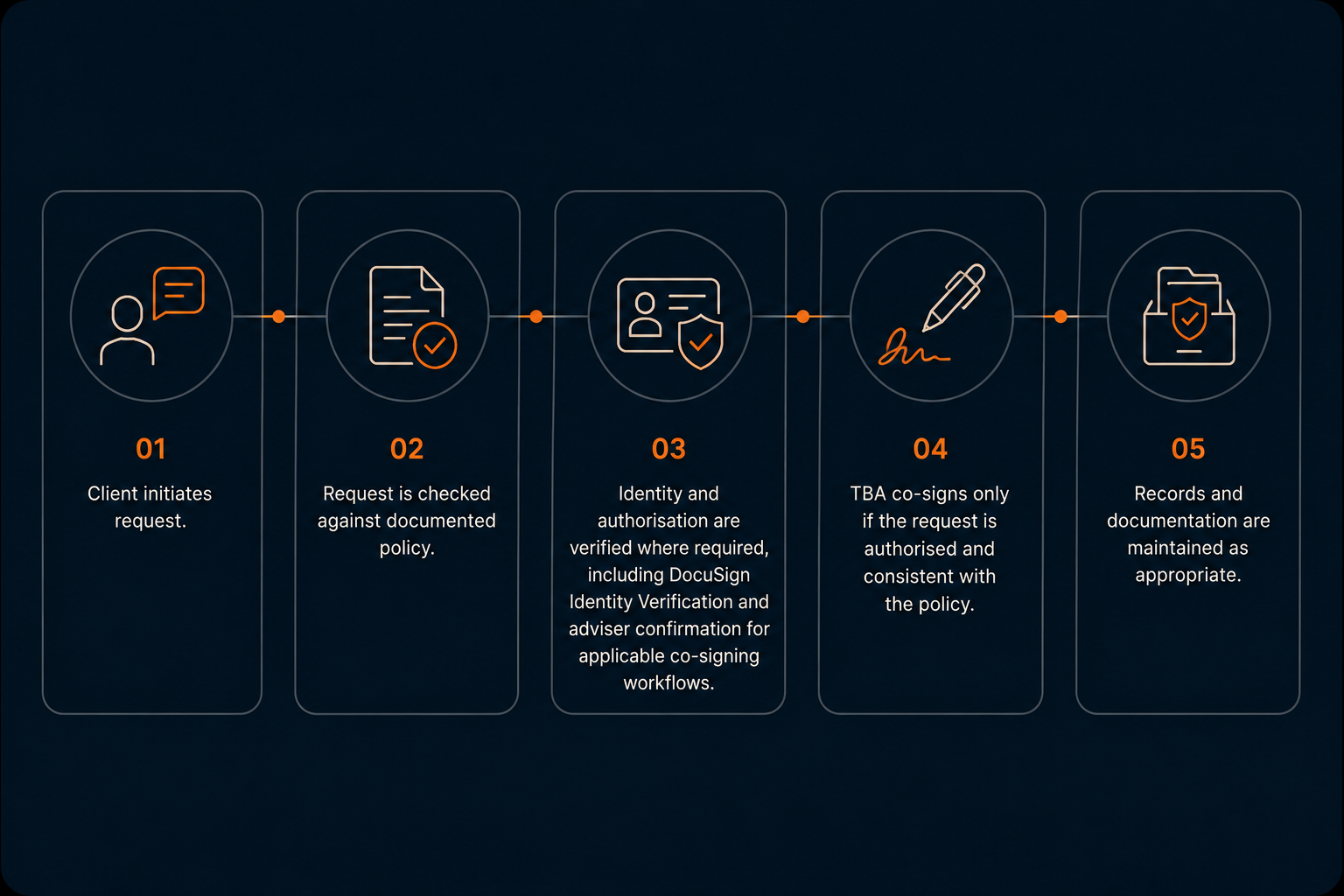
This process applies whether the request comes from you, your family, or a verified executor or trustee acting under documented policy. For how the signing role fits the wider security model, see Key Agent.
Continuity Events and Where To Go
Most Bitcoin problems are not investment problems. They are continuity problems. Use this map to route the situation to the right page.
- Death: Executor Support, then Inherited Bitcoin for crisis triage.
- Incapacity: Estate Planning and Continuity.
- Lost device or signer: Emergency Kit and Key Agent.
- Trustee change: Family Offices and Law Firms.
- Turnover or vendor failure: Corporate Treasury, Key Agent, and Continuity.
This framework is routing, not advice. If you are in an active theft, scam, coercion, or seed exposure situation, prioritise the Emergency Kit and do not act alone. For how continuity fits the wider security model, see Origins of Collaborative Security.
Related Professional Pathways
Continuity problems look different by profession and mandate. These lanes share the same doctrine: legal and organisational authority is not cryptographic authority.
Generational Bitcoin Playbook
The why: stewardship across generations, not a short term trade.
Law Firms
Professional partners: legal authority is not Bitcoin control.
Corporate Bitcoin Treasury
Key person risk, board turnover, and documented handovers for balance sheet Bitcoin.
Sovereign Wealth
Public capital: mandate alignment, committee process, and continuity that survives politics and personnel turnover.
Financial Advisers
Referral lane for Bitcoin clients without stepping outside an advice model.
Designed for Failure Scenarios
Adviser unavailable
Client continues with the existing structure or transitions to another adviser.
TBA unavailable
Client can independently initiate recovery and move funds without The Bitcoin Adviser.
Technology partner unavailable
Recovery remains possible via documented configuration and alternative standard tools.
Multiple failures
Recovery remains possible with quorum and documentation, even under compounding disruption.
Designed to Survive Personnel, Vendor, and Family Change
Continuity exists at the firm and system level, not the individual level. These are the outcomes the operating model is designed to support.
Adviser and firm continuity
Clients work with individual advisers, but the relationship is not architecturally tied to any one person. If an adviser becomes unavailable, clients can transition to another adviser. Senior oversight exists to maintain continuity of service without compromising client security.
Vendor and app independence
Wallet software and custody platforms are interfaces, not gatekeepers. Vendor change is anticipated, not feared. Critically, clients can independently initiate recovery and move funds without The Bitcoin Adviser using their own key and the technology partner's key to migrate funds without our involvement.
Wallet configuration files are embedded in client documentation so no single technology partner can lock a client out, and funds remain recoverable using widely available tools if a provider disappears.
What stops collusion?
A common question: what stops The Bitcoin Adviser and the platform provider from acting together against a client? In a 2 of 3 structure:
- Spends require client initiation plus policy checks before any co signature.
- Neither The Bitcoin Adviser nor the platform provider can move Bitcoin unilaterally.
- Client facing advisers do not hold signing keys or broad account access to client vaults.
For the full trust model, see Collaborative Security or read Addressing the Collusion Question.
Heirs and the Estate Plan Protocol
As part of onboarding, clients are issued an Estate Plan Protocol (EPP) designed to make recovery deliberate and low stress for executors. It includes the client's wallet configuration files and security structure context. It is completed by the client and stored alongside the Last Will and Testament. The Bitcoin Adviser does not retain a copy of the completed EPP.
Funds can be recovered without the EPP; its purpose is to turn keys into an actionable process when families are under stress.
There is no perfect security structure. Every model has tradeoffs. Our focus is survivability: reducing single points of failure and designing for recovery across time, people, and vendors.
Design a Security Structure Built to Last
Most security structures are never tested under failure conditions. We design and rehearse them before they are needed.
If you want continuity by design (no unilateral control, vendor independence, and a documented inheritance path), start with collaborative security and governance led documentation. Explore the Bitcoin Protection Plan for a shareable readiness checklist.
Where TBA acts as a professional key agent, signing is policy governed and authorisation based, still not custody.