

The Bitcoin Control Layer for Public Capital
Sovereign wealth and public-sector balance sheets do not adopt assets the way individuals do. They require mandate alignment, approval architecture, operational evidence, and controls that survive political, personnel, and audit scrutiny.
Public capital requires controls that survive politics, turnover, and time.
We help design the Bitcoin control layer: collaborative security, authorization workflow, evidence-ready procedures, and continuity planning for public-sector capital—without retail timing narratives or price talk.
Clients in the UAE and Gulf: see our UAE & Gulf page for a regional overview. For U.S. operational standards language, see Operational Standards for Sovereign Assets (U.S.).
Continuity is the point: politics, personnel turnover, and election cycles are where public-capital governance fails if the control layer is undocumented. This page is one lane inside the broader continuity doctrine. Related: Continuity · Corporate Bitcoin Treasury · Family Offices.
Important
Bitcoin education, collaborative security design, and for client-controlled Bitcoin, not financial, investment, tax, or legal advice. Bitcoin carries high risks including total loss. Scope, Risks & Important Information →
Public Capital Is Different
Sovereign wealth and state balance sheets sit under a different emotional and operational register than private wealth: national balance sheet implications, public accountability, committee and board decision-making, political scrutiny, procurement and vendor defensibility, and institutional continuity across election cycles and personnel turnover.
This is not a scaled-up family office problem set alone—though the custody primitives rhyme. Here, every movement must trace to mandate, documented approval, and evidence that survives external review. Bitcoin’s bearer nature makes unambiguous authority and executable procedure non-negotiable.
Governance, Not Price
Sovereign wealth funds and public-sector balance sheets optimise for governance, oversight, political risk, operational controls, and audit defensibility. Bitcoin adoption in this context requires mandate-first framing: control environment, operational resilience, continuity, and auditability.
- Control environment. Documented roles, approval thresholds, and change-control procedures.
- Operational resilience. Multi-party redundancy, key-person risk mitigation, incident and duress procedures.
- Continuity. Succession planning and recovery pathways so the system survives personnel changes.
- Auditability. Access logs, signing authorisation workflow, periodic holdings statements, and audit-ready artefacts.
Mandate Through Continuity
Collaborative security is how mandate becomes machinery: no single party can unilaterally move Bitcoin, while approvals, quorums, and thresholds mirror the control language your oversight bodies already expect.
- Mandate alignment Statutory or policy basis for the sleeve; objectives, risk appetite, and reporting lines explicit before architecture work.
- Approval architecture Committee thresholds, dual-control, procurement-friendly vendor posture, and documented gates before any signing event.
- Custody architecture Multi-party vault design, segregation, redundancy, and recoverability matched to your continuity requirements.
- Signing workflow Instruction pathways, identity verification, written authorisation (e.g. DocuSign) where appropriate, and refusal/duress paths.
- Evidence Access logs, change-control records, holdings verification, and artefacts structured for internal and external audit.
- Continuity Succession across personnel and political cycles; rehearsals so the system survives turnover without informal workarounds.
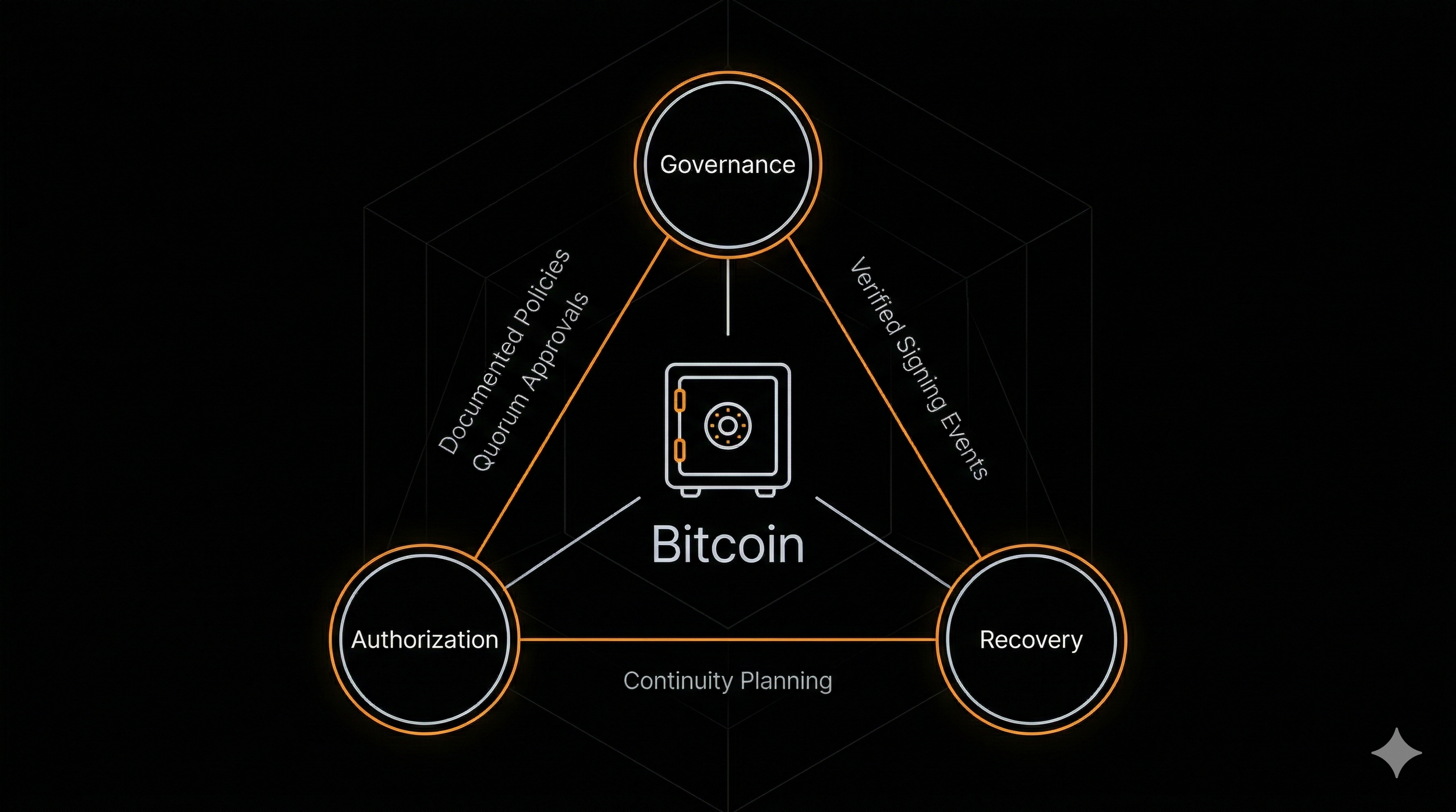
- Change control. Address changes and key updates follow documented steps—reducing operational ambiguity under scrutiny.
- Professional liaison. Adviser-led co-signing so authorised parties are not alone during recovery or high-stakes signing events.
- Deepening. For execution doctrine across documents vs capability, see Legal Authority vs. Control and Collaborative Security.
Governance Implementation Path
A defensible sleeve is built in stages—each stage produces artefacts committees can approve and auditors can trace: architecture alignment → policy pack → pilot vault(s) → runbooks → governed support. We work alongside legal counsel and governance bodies. For legal document integration, see our Law Firms page.
Architecture alignment
Stakeholders, governance expectations, current custody posture, and decision workflow—documented before vault design hardens.
Policy pack
Sleeve memo, role responsibilities, and governance gates so Bitcoin is a governed line, not an informal balance-sheet attachment.
Pilot vault(s)
Multi-signature design and implementation matched to your control model and evidence requirements.
Runbooks & governed support
Signing manuals for authorised parties; reviews and updates as mandates, committees, and personnel change.
Audit-Ready Artefacts
Controls and evidence support board oversight and audit defensibility:
The system must be explainable after the people who designed it are gone—otherwise continuity becomes folklore, and scrutiny becomes exposure.
- Access logs. Documented access and verification events.
- Signing authorisation workflow. Written instruction and verification (e.g. DocuSign) before signing events.
- Periodic holdings statements. Verification of on-chain positions.
- Audit-ready artefacts. Control maps, runbooks, and change-control records suitable for internal and external review.
Risk Register (Illustrative)
Sovereign readers often anchor on a short register of failure modes—then ask how controls and evidence answer each line. The following are typical discussion items, not an exhaustive list for any jurisdiction.
- Unilateral movement risk. Any architecture where one actor can move funds without quorum, verification, or alignment with stated mandate.
- Political and personnel turnover. Knowledge and authority concentrated in individuals who may rotate with administrations or committees.
- Audit evidence gaps. Procedures that work in practice but cannot be reconstructed for oversight bodies or external reviewers.
- Custodian concentration. Single-vendor or single-jurisdiction dependency without documented contingencies.
- Key-person dependency. Recovery or signing paths that collapse when specific individuals are unavailable.
- Emergency signing ambiguity. Duress, incident, or expedited paths that are undefined or inconsistent with ordinary controls.
What You Leave With
Public mandates need a decision pack that boards, investment committees, and procurement can review, challenge, approve, and file: explicit mandate alignment, control maps, workflows, and evidence—not slideware.
Sleeve objectives, role responsibilities, governance gates, and reporting lines—so Bitcoin is a governed sleeve, not an informal balance-sheet line.
Quorum design, segregation, change-control, and system boundaries—readable by risk, legal, and internal audit without translating from vendor jargon.
Instruction pathways, thresholds, verification steps, and refusal paths—mirroring how your organisation already approves material risk.
Documented behaviour under stress: who may act, how escalation works, and how evidence is preserved when timelines compress.
Artefact index, log expectations, holdings verification cadence, and change-control records aligned to your audit model.
Phased vault rollout, runbooks for authorised signers, rehearsal schedule, and handover criteria—so pilot work is defensible, not experimental folklore.
What We Do Not Do
Clear Exclusions
- No custody
- No trading
- No investment advice
- No commingling
- No on-site key holding by The Bitcoin Adviser
Our role is governance design, collaborative security implementation, documentation, and ongoing support. You retain control and responsibility for your keys and holdings.
Sovereign Wealth Funds vs Family Offices
Same custody primitives—multisig, policy, process—but a different stakeholder map and optimisation criteria than family offices: public capital adds mandate discipline, committee process, and evidence that must survive external scrutiny (see Public Capital Is Different above).
Family Offices
Optimise for:
- Family continuity
- Education and next-generation readiness
- Inheritance and succession
Sovereign Wealth & State Capital
Optimise for:
- Governance and oversight
- Political risk and audit defensibility
- Operational controls and evidence
Tailored for Institutional Mandates
Each service is designed to integrate with your governance structure, oversight committees, and existing advisory ecosystem—without introducing avoidable operational ambiguity.
Collaborative Security
Multi-signature vault design that eliminates single points of failure and enables policy-based approvals, documented roles, and recoverability.
Learn more →Governance & Policy
Bitcoin sleeve policy, control maps, and runbooks—documented for board and oversight review.
Operational Support
Ongoing reviews, optional rehearsals, and control updates as stakeholders change.
Learn more →Education & Advisory
Training for authorised signers and governance committees. Reduce operational ambiguity and ensure shared understanding.
Learn more →Request an Institutional Briefing
Use this session to align governance expectations, stakeholders, and your current custody setup.
Schedule an Institutional Briefing with Peter
Use this session to discuss governance expectations, control model design, and your current custody setup.
Book with Peter Dunworth
Questions? Email us to discuss your institutional briefing needs.
Email: peter@thebitcoinadviser.com